
How Much Does Radiant Barrier Installation Cost in Long Beach?
Radiant barrier installation in Long Beach typically costs between $1,800 and $4,200 for a standard 1,500 to 2,500 square foot attic, with most homeowners paying around $2,800. The price per square foot generally runs $0.80 to $2.00 for materials and labor combined. Our written quote includes everything before we start – no surprise line items on the invoice.
We’ve been installing radiant barriers in Long Beach attics since 2003, and the pricing we quote reflects the actual conditions in homes across Naples, Belmont Shore, Bixby Knolls, and the rest of the city. Older homes near the coast tend to have tighter attic access and irregular rafter spacing, which adds labor time. Newer construction in East Long Beach often goes faster because the framing is more uniform. Either way, you’ll have your exact number in writing before our crew pulls a single tool off the truck.
Radiant Barrier Installation Cost Breakdown (2026)
Here’s what radiant barrier installation costs look like in the Long Beach market as of 2026. These are the line items we walk through on every written estimate:
| Cost Component | Typical Range (Long Beach) | Notes |
|---|---|---|
| Radiant barrier foil (materials only) | $0.35 – $0.80 per sq ft | Single-sided or double-sided foil; double-sided runs higher |
| Labor (stapling to rafters or laying over insulation) | $0.45 – $1.20 per sq ft | Varies with attic height, access, and rafter condition |
| Attic access improvements | $100 – $400 | Adding or enlarging a hatch, installing pull-down stairs if needed |
| Removal of old or damaged insulation | $300 – $1,100 | Only if existing insulation is compressed, water-damaged, or rodent-soiled |
| Air sealing (recommended before barrier install) | $400 – $900 | Caulking and foaming top plates, wire penetrations, and recessed light housings |
| Whole attic, 1,500 – 2,500 sq ft | $1,800 – $4,200 | Most common project size in Long Beach |
These numbers are based on what our crews see walking attics from the Craftsman bungalows of Rose Park to the mid-century ranches in Los Altos. A radiant barrier is a reflective foil, usually aluminum, installed along the underside of roof rafters or laid over existing insulation on the attic floor. The foil reflects radiant heat rather than absorbing it, which keeps the attic significantly cooler during Long Beach’s long late-summer stretches when temperatures climb into the 90s.
What moves your number up or down? Attic height is the biggest factor. A walkable attic with a finished floor and 7-foot clearance is faster to work in than a crawlspace where our techs are on their knees between trusses. Rafter condition matters too – if the wood is splintered or has old roofing nails sticking through the decking, stapling foil takes more care. And if your attic already has blown-in fiberglass or cellulose, we may recommend laying the barrier over it rather than stapling to rafters, which changes the material and labor calculation.
One thing to understand: radiant barrier is not a substitute for insulation. It works alongside it. In Long Beach’s Mediterranean climate, where cooling costs drive summer energy bills, a barrier reduces the heat that radiates down through the ceiling into your living space. That means your air conditioner runs less. Pairing a radiant barrier with proper attic insulation – whether fiberglass batts from Owens Corning or Johns Manville, or blown-in GreenFiber cellulose – is the combination that delivers the most noticeable difference.
What Affects Radiant Barrier Installation Pricing in Long Beach
No two attics in Long Beach are the same, even on the same block. Here are the factors that actually move the price:
- Attic size and footprint. A 900-square-foot attic in a Belmont Heights bungalow costs less than a 3,000-square-foot attic in a Park Estates home, but not three times less. There’s a base mobilization cost – travel, setup, and the time to get materials into the attic – that applies no matter the square footage.
- Attic accessibility. Many Long Beach homes built before 1960 have small interior attic hatches in a hallway closet. If the hatch measures under 22 inches wide, our crew may need to enlarge it to safely move barrier rolls and tools through. Homes in Naples with flat or low-slope roofs often have very tight attic spaces that slow the work considerably.
- Rafter condition and spacing. Older homes in Long Beach frequently have rafters that are 24 inches on center or irregularly spaced, which requires more staples per square foot and more careful alignment of the foil sheets. Wood that’s been exposed to decades of humid marine air can be softer and less forgiving to work with.
- Existing insulation situation. If your attic has old, compressed fiberglass that isn’t doing its job anymore, we’ll recommend replacing it before or alongside the barrier. If the existing insulation is in good shape, we can often lay the radiant barrier right over it, which costs less than rafter-stapling.
- Ventilation and air sealing needs. A radiant barrier performs best when the attic is properly ventilated. If your soffit vents are painted over or blocked, or if you have no ridge vent, the barrier will still help but not as much. We may include air sealing in your quote because sealing the gaps where hot air enters your living space makes the barrier’s effect far more noticeable.
- Time of year. Summer is the busiest season for attic work in Long Beach. If you’re flexible and can schedule between November and March, the wait is shorter and that sometimes affects pricing. But we hold our written quote steady – if we hand you a number, that’s the number, regardless of the month.
How to Save on Radiant Barrier Installation
You don’t need to hunt for the lowest bid to get a fair price in Long Beach. Here’s how to keep the project cost reasonable without cutting corners:
Get the attic measured accurately. Before you call anyone, take a rough measurement of your home’s footprint. A 1,200 square foot single-story home has roughly that much attic space. Knowing this helps you compare quotes line by line instead of by bottom-line price alone.
Combine services. If your attic insulation is old, thin, or uneven, doing the insulation replacement and the radiant barrier in the same visit saves on mobilization costs. We often see attics in Long Beach with original 1950s insulation that’s compressed down to an inch or two. Replacing that with fresh Johns Manville or Knauf batts and then adding the barrier is more cost-effective than doing them separately.
Ask whether you need the full attic done. In some homes, the sun beats hardest on the south and west roof planes. A radiant barrier on just those slopes can deliver a meaningful portion of the benefit at a lower price. We’ll tell you honestly if partial coverage makes sense for your house or if full coverage is the better long-term value.
Check for utility rebates. Long Beach residents served by Southern California Edison may qualify for energy-efficiency incentives on attic improvements. These programs change frequently, so we don’t promise them, but we’ll point you toward what’s available so you can check.
The biggest way to avoid overspending is to get a written price before the work begins, with each line item listed so you can see exactly where your money goes. That’s standard practice for us on every single job. If a contractor won’t put the number in writing, walk away. Call us at (562) 471-3972 and we’ll schedule a free attic inspection and give you a written quote with no obligation.
Is Radiant Barrier Worth It in Long Beach?
For most Long Beach homeowners, the answer is yes, with a caveat: the barrier matters most when it’s paired with adequate attic insulation. A radiant barrier installed alone in an attic with R-19 or less of insulation will help, but it won’t deliver the comfort and energy savings you’d get from a properly insulated attic with a barrier on top.
Long Beach’s climate is unusual. We get weeks of marine layer in May and June – what locals call June Gloom – followed by intense dry heat from August through October. The sun beats on your roof deck for hours a day during those months, and roof surface temperatures can reach 140°F or higher. A radiant barrier reflects much of that heat back out instead of letting it radiate into the attic and then through the ceiling into your home.
Here’s what homeowners in neighborhoods like Cal Heights, El Dorado Park, and Wrigley tell us after installation: upstairs bedrooms that used to be 7 to 10 degrees warmer than downstairs are much closer to even. The air conditioner cycles less frequently. And the garage, if it’s under an attic space, doesn’t feel like an oven when you walk in at 4 p.m.
Neil Barron, who leads our Long Beach crew, puts it this way: “Radiant barrier is one of the most direct fixes for a hot second floor. It doesn’t add insulation value, but it stops the heat before it gets to the insulation. And the difference in a late-September heat wave is immediate.”
How We Install Radiant Barrier in Long Beach
You’ll know exactly what to expect before we start, because the written estimate you receive includes the installation method we’ll use on your specific attic. Here’s the process, step by step:
1. Attic inspection and measurement. We walk the attic before quoting anything. We check rafter spacing, existing insulation type and depth, ventilation, and any signs of moisture or rodent activity. This takes 30 to 45 minutes. You’ll see the same technician at the inspection who’ll be on the job, and they’re background-checked and uniformed.
2. Written quote. We hand you a printed price with line items for materials, labor, and any recommended add-ons like air sealing or insulation replacement. That price is what you pay. No verbal estimates, no ranges that expand once the work starts.
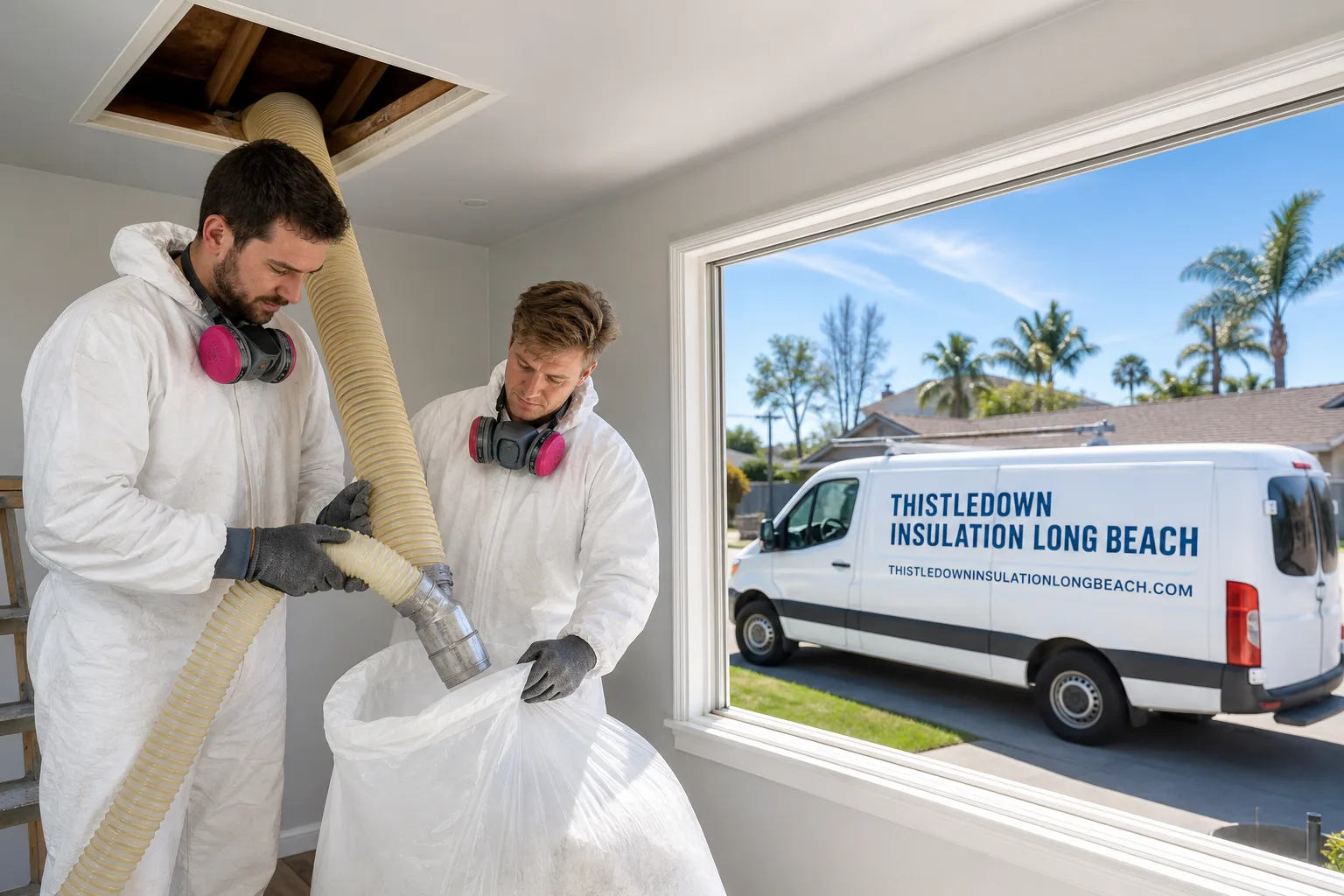
3. Preparation and protection. We lay drop cloths across the hallway path from the front door to the attic hatch. Our crew wears shoe covers the entire time they’re inside your home. If you have pets, we’ll talk about whether they should stay in a different room during the job. Where a pet-safe product option exists among the brands we carry – Owens Corning, Johns Manville, Knauf, Rockwool, CertainTeed, Icynene, Demilec, and GreenFiber – we’ll choose it so the dog or cat can be home without concern.
4. Installation. Depending on your attic configuration, we either staple the foil to the underside of the roof rafters (the most effective method for heat reflection) or lay it over existing floor insulation (common when the attic is used for storage). For rafter-stapling, we maintain a consistent gap for airflow and make sure the shiny side faces the air space. For floor-laying, the reflective side faces up toward the roof deck.
5. Cleanup and photo. Before our van leaves, the attic is free of debris, the drop cloths come up, and we take a photo of the finished workspace and the cleanup. You’ll receive that photo. It’s how we hold ourselves to the standard that started with our name: Thistledown is the soft fluff of the thistle, one of nature’s lightest insulators. The name is a reminder of how carefully we aim to work.
6. 365-Day Done Right Promise. If anything about the installation isn’t right, we make it right within a year. No debate. No fine print. That promise covers the workmanship of our radiant barrier installation, and we state it in writing on every quote.
For a detailed look at what a radiant barrier does and how it performs in Long Beach’s climate, see our Radiant Barrier Installation in Long Beach page. And if you’d like to start with a broader view of what we do, our home page covers the full range of our attic insulation services.
FAQs – Radiant Barrier Installation Cost
How much does radiant barrier cost per square foot in Long Beach?
Expect to pay $0.80 to $2.00 per square foot for radiant barrier installation in Long Beach, including materials and labor. Foil material alone runs $0.35 to $0.80 per square foot, and labor adds $0.45 to $1.20 depending on attic conditions. The total for a typical 2,000 square foot attic lands between $1,600 and $4,000. Call (562) 471-3972 for a written quote that matches your specific attic size and configuration.
Is it cheaper to install radiant barrier myself?
Materials for a DIY radiant barrier can run as low as $0.35 per square foot, so a 2,000 square foot attic would cost around $700 in foil alone. But working in a Long Beach attic in August means 120°F-plus temperatures, tight quarters, and the risk of stepping through a ceiling joist. A professional installation adds the benefit of proper ventilation spacing, air sealing, and the safety of knowing the job is done to the standard of our 365-Day Done Right Promise. For an exact installed price, call (562) 471-3972 – estimates are free.
How much does it cost to add radiant barrier to an existing attic?
Adding radiant barrier to an existing attic in Long Beach typically costs $1,800 to $4,200 for a 1,500 to 2,500 square foot home. The price depends on whether we staple to rafters (higher) or lay the foil over existing insulation (lower), and whether any air sealing or insulation upgrades are included. If your existing insulation is in good condition, the cost stays at the lower end of that range.
Does radiant barrier reduce my energy bill in Long Beach?
A properly installed radiant barrier can reduce cooling costs by 5 to 15 percent in Long Beach homes, based on what our customers report and on standard DOE performance data for reflective barriers in hot climates. The savings are most noticeable during the August through October heat season when roof deck temperatures peak. Pairing the barrier with R-38 or higher attic insulation increases the total savings meaningfully. We’ll give you a straight answer on whether your specific attic setup is likely to deliver those numbers.
Can you install radiant barrier the same week I call?
In most cases, yes. We schedule a free attic inspection within a few days of your call, provide a written quote on the spot, and can typically begin installation within the same week during non-peak months. Summer scheduling may run 1 to 2 weeks out. Call (562) 471-3972 – a live person answers 24 hours a day, every day, and can get you on the schedule right away.
Is radiant barrier safe for attics with pets or children at home?
Radiant barrier foil is a passive, non-toxic material with no fibers or chemical off-gassing, so it’s safe for homes with pets and children. During installation, our crew wears shoe covers, lays drop cloths from your front door to the attic hatch, and keeps the work contained. If we’re also installing insulation, we’ll choose a pet-safe product from the brands we carry – including Owens Corning, Johns Manville, Knauf, Rockwool, CertainTeed, Icynene, Demilec, and GreenFiber – so your animals can stay home comfortably.
Get Your Exact Radiant Barrier Price in Writing
You shouldn’t have to guess what your radiant barrier installation will cost in Long Beach. We’ll inspect your attic, explain what we find, and hand you a written price with every line item spelled out. Then we’ll do the work carefully – drop cloths, shoe covers, quiet tools if the kids are napping – and show you a photo of the cleanup before we leave. It’s the standard we’ve held since 2003 as part of the Cedarwell family of independently owned insulation companies, and it’s backed by our 365-Day Done Right Promise.
Call us at (562) 471-3972 for a free estimate. We answer the phone 24/7, and we’ll get you on the calendar for an attic inspection at a time that works for your family.
Pricing reflects the Long Beach market as of 2026. Thistledown Insulation Long Beach offers free estimates – call (562) 471-3972.
Written by Neil Barron, Owner at Thistledown Insulation Long Beach, serving Long Beach since 2003.
What Our Customers Say
"Removed the old flattened insulation and blew in new. They were so careful not to track anything through the house, booties on, drop cloths down. Cleaned up spotless after."
- Kelvin Osei"Attic insulation with a newborn in the house. The crew was quiet, laid protection on every floor they crossed, and hauled off all the old material. Left it spotless and the house is cozier already."
- Corinne Dyer"Our bedrooms were always cold. They added insulation and air sealed the attic, and were meticulous about cleanup, you'd never know they'd been in the attic. So much cozier now."
- Donna Petrie