
How Much Does Spray Foam Insulation Cost in Long Beach?
Spray foam insulation in Long Beach typically costs between $1.50 and $4.50 per board foot (a board foot is 12″ x 12″ x 1″ of cured foam), which translates to roughly $2,400 to $7,800 for a 1,500-square-foot home. Open-cell foam runs $1.50 to $2.50 per board foot, while closed-cell foam runs $2.50 to $4.50. For a typical Long Beach attic, you’re usually looking at $3,100 to $5,600 before any rebates or incentives.
Those are honest, real numbers for this market. What pushes one Long Beach home to $3,000 and another to $8,000 comes down to a handful of specific variables: the type of foam, how much area needs coverage, access to the attic or crawl space, and whether you’re doing new construction or a retrofit. We’ll walk through each of those below, along with what you can expect to pay for the most common spray foam jobs in Long Beach.
And know this up front: you will have a written price before anyone picks up a tool. That’s how Thistledown Insulation Long Beach has operated since 2003, and it’s not negotiable.
Key Takeaways: Spray Foam Insulation Costs in Long Beach
- Typical spray foam job in Long Beach: $2,400 to $7,800
- Attic-only spray foam retrofit: $1,800 to $5,200
- Crawl space encapsulation with spray foam: $2,800 to $6,500
- Closed-cell foam costs about 40 – 60% more than open-cell but adds structural strength and acts as a vapor barrier
- Most Long Beach homes see a 15 – 30% reduction in cooling costs after a proper spray foam attic job
- Free written estimates: call (562) 471-3972 – a live person answers, 24/7
Spray Foam Insulation Cost Breakdown (2026)
Here’s what we’re quoting in Long Beach as of 2026. These ranges reflect what our crews actually see when we walk Long Beach attics, crawl spaces, and new-construction frames:
| Project Type | Typical Cost in Long Beach | What It Includes |
|---|---|---|
| Attic spray foam (open-cell), ~1,200 sq ft | $2,200 – $3,800 | Rafter bays or attic floor, air sealing included |
| Attic spray foam (closed-cell), ~1,200 sq ft | $3,400 – $6,200 | Rafter bays, moisture-resistant, adds structural strength |
| Crawl space encapsulation with spray foam | $2,800 – $6,500 | Foundation walls or subfloor, vapor barrier, air sealing |
| Whole-home spray foam (new construction), 2,000 sq ft | $6,500 – $14,000 | All exterior walls plus attic or roof deck |
| Rim joist spray foam (basement or raised foundation) | $1,200 – $2,600 | Perimeter rim joists sealed with closed-cell foam |
| Garage ceiling or bonus room retrofit | $1,400 – $3,200 | Air seal and insulate the shared wall/ceiling |
A few notes on what drives those numbers. The biggest cost variable is open-cell versus closed-cell. Closed-cell foam is denser, adds rigidity to your framing, and blocks moisture vapor, which is why it commands the higher end of every range. Open-cell is softer, lighter on the budget, and nearly as effective for sound and thermal insulation in most Long Beach attics. For beach-adjacent homes in Belmont Shore or Naples, where humidity becomes a factor, we often discuss whether closed-cell’s vapor-blocking performance is worth the additional spend before anyone commits to a line item.
The second variable is how much prep and clean-up the job requires. Pulling old fiberglass batts, vacuuming dust and rodent debris, and then foaming takes meaningful labor hours. If your Long Beach attic still has the original 1960s rock wool or a mess of compressed fiberglass from a quick flip renovation, that removal is part of the written price, not a “surprise” line item added on day two.
Third, roof deck versus attic floor placement. Spraying the roofline (making the attic a conditioned space) costs more than spraying the attic floor in most Long Beach homes because it requires more area coverage and more careful masking around vents and recessed fixtures. It also changes how your attic breathes. If your water heater or furnace lives up there, that matters. We walk through this on every estimate. Our job is to explain what we see before we quote you a dollar, so the choice is yours with all the information at hand.
What Affects Spray Foam Insulation Pricing in Long Beach
- Access to the attic or crawl space. Long Beach has an enormous stock of 1920s Spanish bungalows and 1950s stucco ranch homes. Many have tight attic hatches, low-pitch roofs, or crawl spaces with no standing room. Poor access means more labor and more care, and that shows up in the price.
- How much old insulation needs to go. If we need to remove and bag old fiberglass or rock wool, that’s removal labor plus disposal. It is always in the written estimate. Nothing shows up later that we didn’t name up front.
- Number of penetrations to air-seal. Recessed lights, plumbing vent stacks, exhaust fan housings, and electrical boxes all penetrate the attic floor or ceiling. Each one needs masking and sealing around the foam. More penetrations means more time and more material. Long Beach homes with 1970s-era can lights often need extra care here, especially around older wiring.
- Open-cell vs. closed-cell foam. Closed-cell runs 40 – 60% more per board foot, but it adds measurable strength to your roof deck, which matters in older Long Beach homes with 2×4 rafter framing. It also resists moisture, a real consideration in Naples, Belmont Shore, and any home within a few blocks of the water.
- Climate and moisture considerations. Long Beach’s marine layer and winter dampness mean we pay attention to air sealing quality, not just R-value. A gap around a vent stack lets in moisture-laden air, and foam does not erase that. Proper sealing before foam application adds time, and time is part of the estimate.
- Home age and framing condition. Older Long Beach homes sometimes have dry rot, termite damage, or loose knob-and-tube remnants in the attic. We don’t do structural repairs, but we do flag what we see before spraying, and we will not spray over compromised areas. A good job starts with an honest walk-through.
Long Beach Neighborhoods and How They Affect Cost
Long Beach is not one housing market. It is a patchwork of neighborhoods, each with its own housing stock and insulation realities. Here’s what we see by area:
- Belmont Shore and Naples: Water-adjacent homes with salt air. Closed-cell foam’s vapor-blocking ability is a serious consideration here. Expect pricing on the upper end when the roof deck is sprayed.
- Bixby Knolls and California Heights: 1920s – 1940s homes with tight attics and older framing. Access labor is real. If the original plaster lathe is still in place, we work around it, not through it.
- Lakewood Village and the Plaza: Mid-century tract homes with flat or low-slope ceilings. Many have cathedral-style ceilings with no attic at all, which means foam is applied to the underside of the roof deck from inside the living space. That’s a more surgical job and a higher labor line.
- Downtown and East Village: Condos and lofts with shared walls. We often focus on rim joist sealing and shared-wall sound control rather than whole-attic work.
- North Long Beach: Larger lots, sometimes with additions built to code from different eras. Mixed framing and older insulation in the add-on sections are common.
The area of Long Beach you live in doesn’t change our hourly labor rate, but it does change how long a job takes and what kind of foam fits your home. That’s why we give written quotes after walking the actual space, not over the phone.
Understanding the Cost per Board Foot
We measure spray foam by the board foot: one square foot of coverage at one inch thick. A 1,200-square-foot attic with 2×8 rafters being sprayed to 3.5 inches of open-cell foam involves about 4,200 board feet of material. At the lower end of $1.50 per board foot, the material line alone sits around $6,300 before labor and prep. This is the arithmetic every honest estimator uses, and it’s why we show it right on the estimate.
Two identical 1,200-square-foot Long Beach attics can quote differently if one uses open-cell and the other closed-cell, or if one contains 15 can lights and the other has none. We believe you should see the math. When we hand you a written price, it is built from measured dimensions, not a percentage guess.
Spray Foam vs. Traditional Insulation: What You’re Really Paying For
Spray foam runs about two to three times the cost of blown fiberglass or batt insulation per installed R-value. So why do Long Beach homeowners choose it? Three measurable reasons:
- Air sealing. Spray foam is the only insulation that expands to seal gaps as it insulates. Fiberglass and cellulose slow heat transfer, but they do not stop air movement. In a city where summer attic temperatures hit 130°F, trapped hot air leaking into living spaces is a comfort and cost problem that air sealing actually fixes.
- Longevity. Spray foam does not settle or compress over decades the way blown fiberglass does. We’ve pulled 20-year-old fiberglass from Long Beach attics that had dropped from R-30 to R-19 because of settling and moisture. Foam stays where it is sprayed.
- One product does two jobs. Closed-cell foam insulates and acts as a moisture barrier. In Long Beach’s coastal humidity, especially near the water, that’s a meaningful benefit that fiberglass simply doesn’t offer.
The honest trade-off is that spray foam costs more on day one. Our job during a free estimate is to explain what makes sense for your specific home. Sometimes the right answer is spray foam in the attic and blown fiberglass in other areas. We install eight brands, including Owens Corning, Johns Manville, Knauf, Rockwool, CertainTeed, Icynene, Demilec, and GreenFiber, so we are not married to one product. We’re married to what’s right for your house.
What Does a Full Spray Foam Insulation Project Include?
When we hand you a written price for our Spray Foam Insulation services in Long Beach, here’s what it covers:
- The removal and disposal of old insulation, if needed. We bag it, haul it out without dragging it through your living room, and leave the attic floor clean.
- Air sealing around all penetrations. Recessed lights, vent stacks, junction boxes, and top plates get sealed before foam is applied, so the foam’s performance isn’t undercut by air leaks.
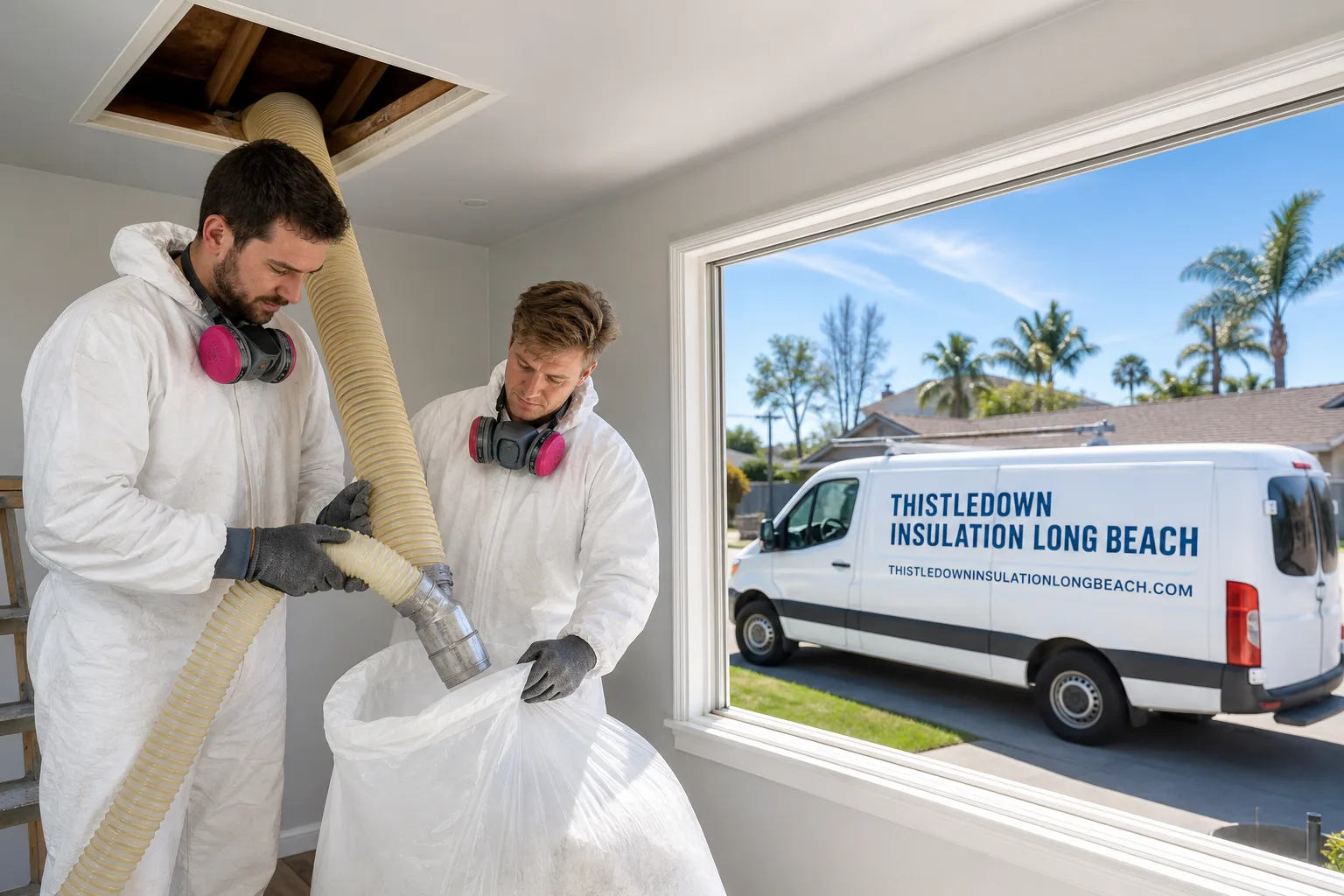
- Masking and protection. We protect attic access, vents, and any areas we’re not foaming. Inside the home, drop cloths go down from the front door to the attic hatch. Shoe covers go on at the door and stay on until we leave.
- The foam application itself. Mixed on-site and sprayed to the depth and coverage specified in your written estimate. We use products from Demilec and Icynene for spray foam applications, chosen for their consistency and low off-gassing profiles.
- Verification of coverage. We check foam depth with gauge pins, confirm coverage around penetrations, and take photos before, during, and after.
- A photo of the clean-up. Before we leave, you get a photo showing the attic finished and the protected areas of your home clean. The van doesn’t pull away until you’ve seen it.
None of these steps are optional add-ons. They’re the job. That’s the Cedarwell Care Promise, and it applies to every single Thistledown visit.
How to Save on Spray Foam Insulation in Long Beach
Spray foam is a premium product, but there are legitimate ways to keep the final number reasonable without cutting corners:
- Prioritize the areas that matter most. If a full roof deck is over budget, we can foam the attic floor and air-seal the penetrations. That captures most of the thermal benefit at a lower material cost. You can always add more later.
- Time it with other attic work. If you’re already having electrical work, HVAC changes, or a roof repair done, coordinating the insulation while the space is accessible can reduce labor hours. We work alongside other trades when we can.
- Ask about open-cell for non-moisture-critical areas. Open-cell is genuinely cheaper and performs beautifully in most Long Beach attics. It’s not a compromise product, it’s just a different tool.
- Check for utility rebates. LADWP and Southern California Edison have offered insulation rebates in recent years, and some programs apply to spray foam. We help you identify what’s current when we do the estimate. Rebates change, so we verify rather than promise.
- Get a written estimate and compare it honestly. Free estimates are the standard, not the exception. Call (562) 471-3972 and we’ll walk your attic, measure the space, and hand you a written price. Compare it against what other companies quote, but look at what’s in the number. If one bid omits old-insulation removal and another includes it, they’re not the same job.
Is Spray Foam Insulation Worth It in Long Beach’s Climate?
Long Beach is not Phoenix and it’s not Seattle. Our climate is mild, with summer highs in the 80s and winters that rarely dip below 45°F. That means the payback math on insulation is different here than in more extreme climates. If your only metric is raw payback period, spray foam may not pencil out as quickly in Long Beach as it does in, say, Las Vegas or Minneapolis.
But comfort is the point for most of our Long Beach customers. A second-floor bedroom that bakes every August afternoon. A living room that smells musty in January because moist ocean air migrates through the attic. A nursery that’s always five degrees warmer than the rest of the house. Spray foam addresses those directly, and that’s what people tell us they wanted fixed. We’re not here to oversell. We’re here to explain what the product does and what it costs, then let you decide.
That said, sealed attics and proper air sealing do measurably reduce cooling load in the warm months, and many Long Beach homeowners report their air conditioning runs noticeably less on hot afternoons after a roof-deck foam job. Those are the real-world outcomes we hear about after the work is done, not before.
Pet and Family Safety During Spray Foam Installation
We know who lives in your home. Spray foam installation is an active chemical process during application, and the people who live in the house, especially children, pregnant women, and anyone with respiratory sensitivities, should not be inside during the spraying and the re-entry window that follows. We explain this clearly before scheduling, and we plan the job around your family’s schedule, not the other way around.
Pets should be out of the home during application too. We choose pet-safe where choices exist, and we ask before moving anything, including a food bowl or a bed. When the job is done and the re-entry window has passed, there’s no ongoing off-gassing or odor with properly installed, fully cured foam. We use low-VOC products from Demilec and Icynene where suitable, and we’ll tell you if a specific product has any specific re-entry guidance. Sleeping children and curious dogs are not afterthoughts in our scheduling. They’re the first thing we plan around.
Spray Foam Insulation Cost FAQ
How much does spray foam insulation cost in Long Beach?
Spray foam in Long Beach runs $1.50 to $4.50 per board foot depending on whether you choose open-cell or closed-cell. A typical attic job lands between $3,100 and $5,600. Your written estimate will reflect the actual measurements from your home, not a generic range. Call (562) 471-3972 for a free walk-through and exact number.
Is spray foam insulation more expensive than fiberglass?
Yes, spray foam typically costs two to three times more per square foot than blown fiberglass or batt insulation. The trade-off is that spray foam also air-seals, does not settle over time, and (in closed-cell form) blocks moisture vapor. Whether that’s worth it depends on your home and your priorities. We’ll walk through both options and quote both if you’d like to compare.
What’s the cost difference between open-cell and closed-cell spray foam in Long Beach?
Open-cell runs about $1.50 to $2.50 per board foot, while closed-cell runs $2.50 to $4.50 per board foot. Closed-cell adds structural reinforcement and acts as a vapor barrier, which is why it commands the premium. For most Long Beach attics, open-cell is sufficient. For crawl spaces and homes near the water, closed-cell is often the better call.
Can you spray foam just part of an attic?
Yes. We frequently quote partial attic projects, like spraying just the roof deck over the master bedroom or air-sealing and foaming the attic floor in one section while leaving the rest as-is. The cost for a partial job starts around $1,000 to $2,000 depending on access and penetration density. Call (562) 471-3972 and we’ll tell you what’s practical for your specific space.
How long does spray foam installation take in Long Beach?
A typical attic spray foam job takes one full day, including prep, removal of old insulation (if needed), spraying, and clean-up. Larger whole-home projects can run two to three days. Re-entry for residents usually follows the manufacturer’s re-occupancy window, which we explain clearly before scheduling. We schedule around your family, and we leave a clean house and a photo of the finished attic before we go.
Why Long Beach Homeowners Choose Thistledown
Thistledown is the soft fluff of the thistle, one of nature’s lightest insulators. The name is a promise about how carefully we work. We are an independently owned Cedarwell-family company, founded in 2003, and we install spray foam insulation in Long Beach every week. Neil Barron leads our crew, and the standards he holds are specific: every customer gets a written price before any work starts. Every technician is background-checked and uniformed. Every call is answered by a live person, 24 hours a day, seven days a week. Every visit includes shoe covers, drop cloths, and a photo of the clean-up before we leave.
If the work isn’t done right, the 365-Day Done Right Promise means we make it right. No debate. No fine print. That’s how it’s been since 2003, and that’s how it stays.
Get Your Written Spray Foam Estimate
If you’re considering spray foam insulation for your Long Beach home, the next step is simple. Call (562) 471-3972 and a live person will answer, day or night. We’ll schedule a walk-through of your attic or crawl space, measure what needs to be done, answer every question you have, and hand you a written price before any work begins. No pressure, no vague ranges, no surprise line items. Just a specific number and a plan for getting it done right.
We treat your house like our own home. That means clean floors, quiet tools when little ones are napping, product choices that keep pets safe, and a price you can hold us to. Thistledown Insulation Long Beach is ready when you are.
Pricing reflects the Long Beach market as of 2026. Thistledown Insulation Long Beach offers free estimates – call (562) 471-3972.
Written by Neil Barron, Owner at Thistledown Insulation Long Beach, serving Long Beach since 2003.
What Our Customers Say
"Attic insulation with a newborn in the house. The crew was quiet, laid protection on every floor they crossed, and hauled off all the old material. Left it spotless and the house is cozier already."
- Corinne Dyer"Our bedrooms were always cold. They added insulation and air sealed the attic, and were meticulous about cleanup, you'd never know they'd been in the attic. So much cozier now."
- Donna Petrie"Attic insulation. The crew laid down protection from the front door to the attic hatch and vacuumed up every bit of the old material. House holds its warmth now and there was zero mess."
- Rowena Platt