
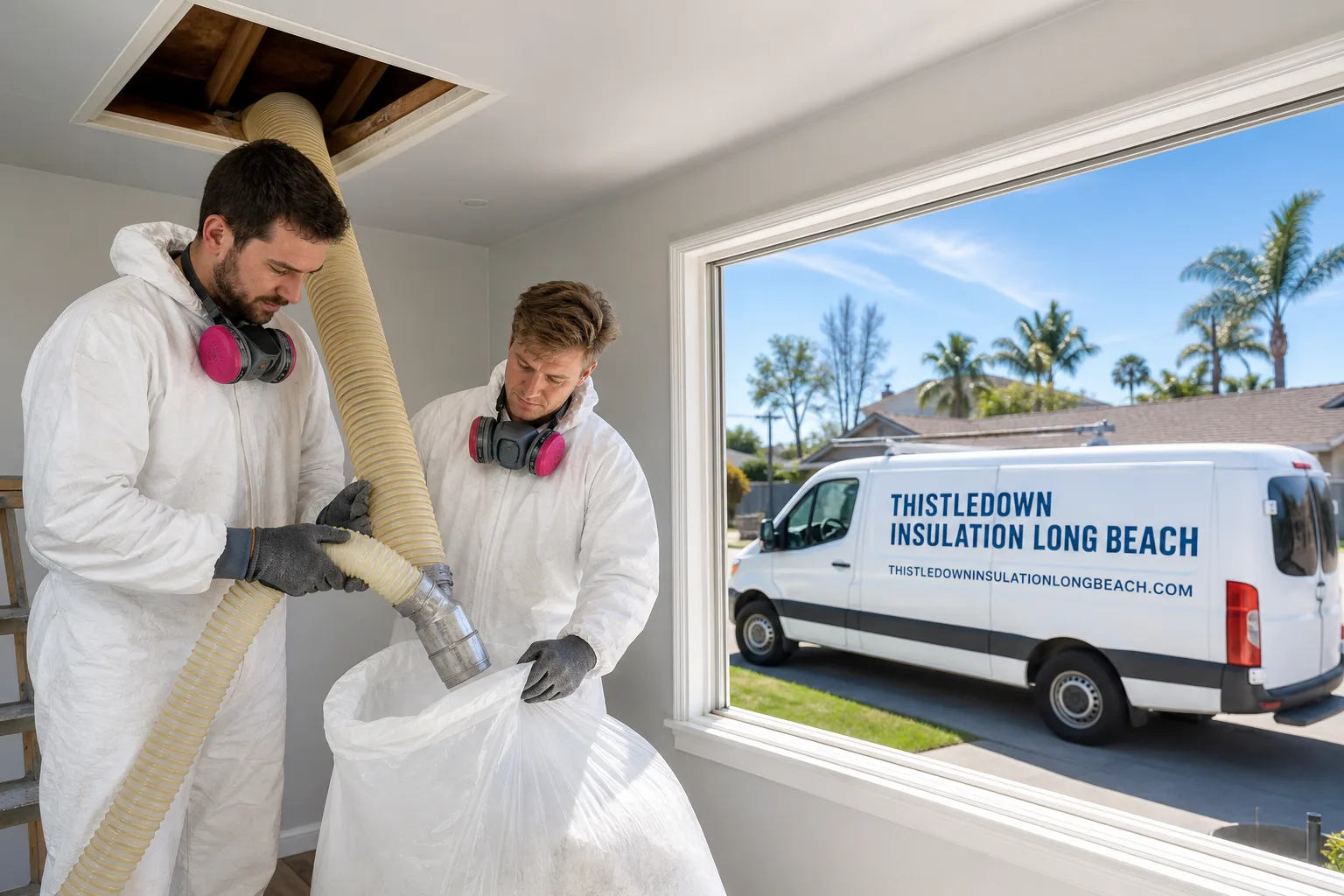
Fast, Reliable Spray Foam Insulation Across Seal Beach
Spray foam insulation in Seal Beach typically costs $2.50 to $7.00 per board foot installed, with most whole-attic projects landing between $3,800 and $9,400 depending on square footage and foam type. We get calls from College Park East, Old Town, and the Hill every week, and our crews usually reach Seal Beach doorsteps within 90 minutes of your call. If you’re dealing with a salt-air corroded crawl space west of Pacific Coast Highway or a dust-packed attic east of the 405, call (562) 471-3972 and we’ll give you a written price before any work starts.
Why Thistledown Insulation Long Beach Is Seal Beach’s Preferred Spray Foam Insulation Company
Seal Beach homeowners keep calling us back because we explain exactly what product goes near the kids’ rooms and what the floors will look like when we leave. Every crew member is background-checked and wears a uniform, so you know who’s walking through your front door. We lay drop cloths across your hallway, wear shoe covers from the front door to the attic hatch or crawl space entry, and send you a photo of the clean-up before the van pulls away. That’s the Cedarwell Care Promise, and it’s not an upsell.
Our customers in The Hill and College Park East tell us they appreciate that we never quote a vague range and then “adjust” it later. You get a written price before anyone picks up a tool, every single time. And because we install eight insulation brands including Owens Corning, Johns Manville, and Icynene, we’re not tied to one product that may not fit your 1950s single-wall construction or your 1920s beach cottage. Neil Barron, who leads our team, insists on matching the foam to the house, not the other way around.
We answer our phones with a live person 24 hours a day, seven days a week. No voicemail trees. If you call at 6 a.m. because the marine layer set in overnight and you want someone to look at your crawl space before work, a real human picks up.
Spray Foam Attic Insulation in Seal Beach
Spray foam attic insulation in Seal Beach means sealing the roof deck or attic floor against two things most attic insulation can’t handle: salt air west of Pacific Coast Highway and decades of fine dust blowing in from the sea breeze east of the 405. The job involves either spraying open-cell foam directly on the underside of the roof deck to create an air barrier, or applying closed-cell foam to the attic floor after removing failed or compacted insulation. Homeowners in Seal Beach usually need this when original 1950s or 1960s batt insulation has compressed to half its rated R-value, when attic temperatures swing wildly between morning marine layer chill and afternoon sun, or when dust from the San Gabriel River channel and coastal breezes keeps sifting down through ceiling cracks.
A full attic spray foam project in Seal Beach typically runs $4,800 to $9,400 for an average 1,200-to-1,800-square-foot home. Smaller attics in Old Town cottages can come in closer to $3,800. You’ll have the exact written number before we start, and the 365-Day Done Right Promise stands behind the work: if it’s not done right, we make it right, no debate.
Roof Deck Foam for Dust-Prone Attics East of the 405
Homes east of the 405, especially in College Park East and Rossmoor-adjacent streets, collect a shocking amount of wind-driven dust in attics. Open-cell foam applied to the roof deck creates an air seal that keeps that dust from entering the living space, while also cutting the noise from freeway and Naval Weapons Station traffic.
Open-Cell vs. Closed-Cell in Seal Beach Attics
Open-cell foam runs about $2.50 to $4.00 per board foot and works well for most Seal Beach attics because it’s forgiving on older framing and provides excellent sound dampening. Closed-cell foam, at $4.50 to $7.00 per board foot, adds structural strength and a vapor barrier, which matters if your attic shows signs of salt-air moisture intrusion or you’re converting attic space. We’ll recommend one option for your specific house, not a one-size-fits-all product.
Spray Foam Wall Insulation in Seal Beach
Spray foam wall insulation in Seal Beach is most common in the 1920s and 1930s beach cottages in Old Town and the 1950s single-wall construction homes in College Park East and The Hill, where original walls were built with little or no insulation. The job involves either drilling small access points and injecting foam into existing wall cavities, or spraying foam directly onto studs during a remodel before new drywall goes up. Seal Beach homeowners ask for wall foam when rooms facing Pacific Coast Highway or the railroad tracks stay loud at night, when exterior walls feel damp or cold to the touch in the morning marine layer, or when energy bills creep up as coastal air seeps through uninsulated wall cavities.
Wall cavity foam injection in Seal Beach usually runs $3,200 to $6,800 for an average home, depending on how many exterior walls are treated and whether we’re working around existing wiring and plumbing from the 1950s. For open-stud applications during remodels, the cost is typically $4,500 to $8,200. You’ll always get a written price first, and our crews treat your walls like they’d treat their own: drop cloths down, shoe covers on, and a photo of the finished, swept space before anyone leaves.
Wall Cavity Injection for Old Town Beach Cottages
Old Town homes built before 1940 often have no wall insulation at all, just plaster on lath over empty stud bays. We inject open-cell foam through small holes that we patch and touch up, leaving the original character of the cottage intact while cutting noise from Pacific Coast Highway and the pier area.
Moisture-Safe Wall Foam for Marine Layer Exposure
West of Pacific Coast Highway, the persistent morning marine layer means wall insulation must handle high humidity without trapping it. We specify closed-cell foam or open-cell foam with a vapor retarder on those exterior walls, so the 1950s sheathing doesn’t rot from the inside while the foam is doing its job.
Trusted Brands We Service in Seal Beach
We install and service spray foam products from Owens Corning, Johns Manville, Knauf, Icynene, Demilec, and GreenFiber, which means we’re not locked into one manufacturer’s spec sheet. If your Seal Beach crawl space needs a closed-cell foam that stands up to salt air, we’ll spec Demilec or Icynene. If your attic needs open-cell foam with better sound attenuation for PCH traffic noise, we’ll match that job to Owens Corning or Johns Manville. Because we stock parts and materials locally for Seal Beach jobs, turnaround on estimates, materials delivery, and installation is consistently faster than fly-by-night crews who order everything from a distant warehouse. Ask about pet-safe product options where a choice exists, especially if your dog will be home during the job.
Common Spray Foam Insulation Problems We See in Seal Beach Homes
- Salt-air corrosion in west-of-PCH crawl spaces. Homes west of Pacific Coast Highway get hit with salt-laden air every day. Spray foam on crawl space walls that wasn’t specified for coastal exposure can lose adhesion within a few seasons, peeling away from the foundation and letting moisture back in. We use closed-cell foam rated for marine environments and always check the vapor barrier beneath it.
- Compacted attic insulation east of the 405 from sea breeze dust. Decades of fine dust blowing in from the coast settles into attic insulation and compresses it until it’s working at half capacity or less. If you live in College Park East or near Los Alamitos, your attic batts may look fluffy but test like they’re barely there. Spray foam air-sealing stops the dust at the source.
- Moisture trapping in 1950s single-wall construction. Old Town and College Park East homes built with single-wall construction, meaning no sheathing between siding and studs, need special attention. If open-cell foam is applied directly against the back of the siding without a vapor retarder, the morning marine layer can condense inside the wall cavity and rot the framing from the inside out. We always check the wall assembly before specifying foam.
- Failed vapor barriers from salt air and age. Crawl space vapor barriers in Seal Beach homes often disintegrate from salt exposure and decades of damp soil, leaving the floor assembly exposed to moisture. This undermines any insulation above it, including spray foam. We replace the barrier, air-seal the rim joists, and then apply foam so everything works together.
Pricing for Spray Foam Insulation in Seal Beach, CA
Spray foam insulation pricing in Seal Beach is driven by a few local factors: whether your home is west of PCH where salt-air-resistant closed-cell foam is often required, how much existing insulation needs to be removed first, and whether we’re working in a tight 1920s crawl space or a more accessible 1960s attic. Here’s what we typically see:
- Attic spray foam (roof deck): $4,800 – $9,400 for an average Seal Beach home
- Wall cavity foam injection: $3,200 – $6,800 for a 1,200 – 1,800 sq ft home
- Crawl space rim joist sealing and foam: $2,100 – $4,300
- Open-cell foam: $2.50 – $4.00 per board foot
- Closed-cell foam (salt-air-rated): $4.50 – $7.00 per board foot
These are honest ranges, not vague “it depends” numbers. Your exact written price comes after we inspect your attic or crawl space, and it’s yours before any work starts. Call (562) 471-3972 for a free estimate, and we’ll give you a number you can take to the bank, not a range that balloons later.
We Also Serve Cities Near Seal Beach
Our crews work throughout the coastal Orange County and Los Angeles County border area. If you’re in Seal Beach and need spray foam today, we’re already nearby. We also handle projects in Los Alamitos, Cypress, Huntington Beach, and Midway City. Same written price promise, same 365-Day Done Right Promise, same crew care standards on every job. For more detail on what spray foam insulation involves, see our Spray Foam Insulation page.
Serving Seal Beach, CA - Our Local Coverage Area
We’re based in the Seal Beach area and know this community well. Use the map below to see our service coverage - if you’re nearby, we can almost certainly help.
FAQs About Spray Foam Insulation in Seal Beach
The morning marine layer means high humidity and cool temperatures that linger into midday, which affects how spray foam cures and how older pier-and-beam homes handle moisture. In a pier-and-beam home, the crawl space stays damp for hours each morning, so we typically air-seal the rim joists with closed-cell foam and ensure the vapor barrier is intact before applying any foam to the floor assembly. Applying open-cell foam without that prep can trap moisture against the floor joists. Call (562) 471-3972 and we’ll inspect your crawl space before recommending any foam.
Yes, spray foam significantly reduces PCH traffic noise in Old Town homes, especially when applied to exterior wall cavities and the attic roof deck. Open-cell foam is particularly effective at dampening sound because its airy structure absorbs vibration rather than transmitting it. We’ve had customers on 1st and 2nd streets tell us they can finally sleep with windows cracked after we foamed their west-facing walls. An exact quote is a phone call away.
If the crawl space insulation is corroded, sagging, or peeling from salt air west of Pacific Coast Highway, patching it usually buys you a season or two at most. Salt air keeps working on the same materials. We recommend removing the failed insulation, repairing or replacing the vapor barrier, and applying closed-cell spray foam to the rim joists and crawl space walls. The closed-cell foam doesn’t absorb moisture the way fiberglass batts do and holds up better to coastal air. Call us for a written price and we’ll show you the difference.
No, not effectively. Old compacted batt insulation in a College Park East attic has to come out before spray foam goes in, because the foam needs direct contact with the roof deck or attic floor to seal properly. Our crew removed the compressed original fiberglass from a 1958 pier-and-beam home on the College Park East side, then air-sealed with closed-cell foam before applying open-cell foam in the floor assembly. The result restored the attic’s R-value and stopped dust intrusion. We’ll walk you through exactly what removal involves and what it costs before we start.
Spray foam stops dust intrusion by sealing the air pathways that carry dust into your living space, specifically the attic bypasses around ceiling penetrations, the rim joists, and gaps in the roof deck. East of the 405, sea breeze-driven dust enters through those openings constantly. Once foamed and air-sealed, the dust stays outside where it belongs. If you’re noticing a film of fine dust on furniture soon after cleaning, that’s a sign to call (562) 471-3972.
If your Seal Beach attic or crawl space needs someone who’ll explain the job before starting, put shoe covers on at the door, and leave you a photo of the clean-up, call Thistledown Insulation Long Beach at (562) 471-3972. We’ll give you a written price before any work begins, answer every question you have about foam near the kids’ rooms, and stand behind the job with our 365-Day Done Right Promise.
Written by Neil Barron, Owner at Thistledown Insulation Long Beach, serving Seal Beach since 2003.